

The digital customer journey has undergone a silent yet structural transformation. For years, predictable consumer behavior supported acquisition models centered around a single entry point: traditional search engines. In that context, dominating Google meant controlling the primary flow of discovery and consideration throughout the journey.
The decentralization of entry points—driven by social media, marketplaces, and AI engines within businesses—has reshaped the search landscape. What was once a relatively linear journey has become a distributed ecosystem of interactions, where different channels play specific roles throughout the buying process.
For e-commerce leaders, this shift is more than just a behavioral evolution. It represents a redefinition of what it means to be discoverable—and, consequently, how to build competitive advantage in digital acquisition. Read on to better understand this transformation.
How does search fragmentation impact the customer journey?
A superficial interpretation of this scenario might suggest a loss of relevance for traditional search engines. That view is incomplete. What’s happening is not replacement—but fragmentation.
Search remains the primary mechanism connecting intent to supply. However, that intent is now distributed across multiple platforms, each with its own relevance logic, content formats, and decision-making dynamics.
Informational and navigational queries are still largely captured by Google, although they are already showing signs of migration toward conversational, AI-driven interfaces for business. At the same time, product discovery—especially in visually driven or aspirational categories—has consolidated within short-form video platforms, where content doesn’t just respond to demand, but actively creates it within the journey itself.
At the later stages of the buying journey, marketplaces have taken center stage as decision environments. They are no longer just transaction channels, but true search engines with explicit commercial intent—where users arrive ready to convert.
This shift fundamentally changes acquisition logic. Qualified traffic is no longer concentrated in a single channel—it is distributed across multiple touchpoints.
Why a single-channel strategy doesn’t scale
Most e-commerce operations still structure their visibility strategy around siloed channels. SEO, paid media, and marketplace presence are often managed independently, with disconnected goals and metrics.
This model not only limits growth potential—it creates a structural risk of invisibility. In a landscape where consumers move across multiple environments before converting, being present in just one stage of the journey means competing for only a fraction of the decision. Every uncovered stage is an opportunity handed to competitors.
This becomes even more critical when viewed through the lens of attribution. Traditional models tend to overvalue the last click, ignoring the influence of discovery and consideration channels. As a result, investments are skewed toward bottom-of-funnel touchpoints, while early-stage opportunities remain underleveraged.
How is AI for business reshaping search?
The rise of AI engines adds a new layer to search dynamics. Unlike traditional search engines that return lists of results, these interfaces synthesize information, present options, and often directly influence consumer choice throughout the journey.
This behavior changes the nature of visibility. It’s no longer just about ranking—it’s about being selected as a trusted source within an algorithmic curation process, a shift closely tied to the advancement of AI for business.
For companies, this means a shift in focus: from page-level optimization to building distributed authority. Content, structured data, presence across external sources, and information consistency now form the set of signals that determine whether—and how—a brand is referenced by these systems. Absence in this layer means exclusion from an increasingly important part of the decision-making journey.
If you want to understand how this transformation impacts overall strategy, continue reading: Operationalizing AI: The 5 Levels Of Maturity.
What is “Visibility Engineering” in the customer journey?
In this context, channel-level optimization is no longer sufficient. The challenge becomes orchestrating presence across the entire customer journey, accounting for the nuances of each touchpoint.
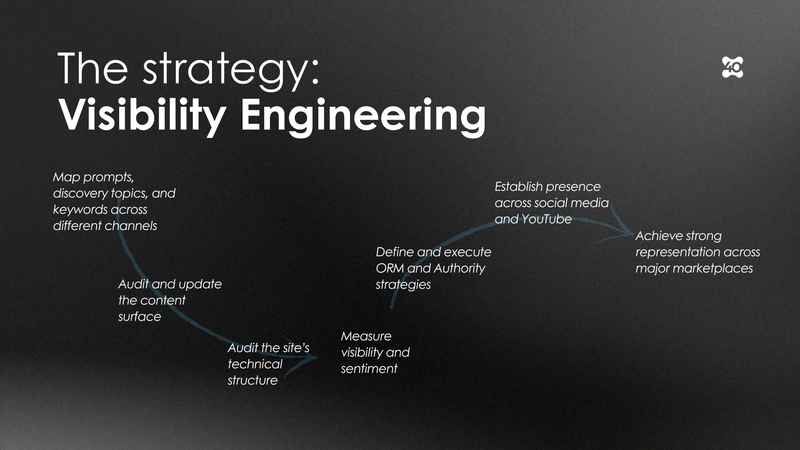
This is where the concept of Visibility Engineering emerges—developed by hub40 as an operational discipline to address search fragmentation.
The core principle is simple, although execution is complex: build relevance and authority across all environments where consumers make decisions—not just where the company has historically operated. This approach unfolds across six integrated fronts:
1. Channel-based intent
Mapping intent by channel helps understand how search behavior varies across platforms. The same need manifests differently depending on context, requiring tailored content strategies for each environment.
2. Content audit
Auditing the content surface expands this logic by evaluating whether existing assets effectively address different intents and formats. Identified gaps are not just SEO opportunities—but strategic visibility opportunities.
3. Technical structure
Technical infrastructure plays a cross-functional role. In an environment where multiple crawlers access and interpret content, factors like semantics, performance, and information architecture become foundational to digital visibility.
4. Data analysis
Measurement must evolve to reflect this complexity. Traditional metrics such as rankings and CPC are no longer sufficient. Indicators like AI share of voice, external citations, and traffic distribution by source provide a more accurate view of performance.
5. Digital PR
Reputation management takes on a new level of importance. In a context where algorithms select sources based on trust, consistency, and authority, building and maintaining a digital presence becomes a proactive driver of demand.
6. Multichannel presence
Marketplace presence is now a baseline requirement for e-commerce operations. It’s not just about channel diversification—it’s about ensuring participation in one of the primary entry points of the customer journey.
Explore hub40’s case studies to see how different companies are structuring their visibility in practice.
The impact of artificial intelligence
Adopting a multichannel visibility strategy generates impact beyond traffic volume. By reducing dependence on specific platforms, diversified traffic sources mitigate risks associated with algorithm changes and bring greater stability and predictability to acquisition during the decision process.
Traffic quality also improves. Users coming from AI interfaces or social discovery channels tend to arrive with higher context and intent, shortening buying cycles and increasing conversion rates.
From an economic standpoint, this combination leads to a more efficient acquisition structure. Reduced reliance on paid media lowers customer acquisition costs, while higher conversion rates drive revenue growth with stronger margins.
This is not just a marketing shift—it’s a transformation in the business growth model, directly aligned with the evolution of AI in digital strategies.
What is the future impact of AI on search and e-commerce?
The evolution of search is not an isolated phenomenon—it’s part of a broader transformation in how consumers interact with technology. The rapid adoption of AI interfaces as discovery and decision channels signals a structural shift with the potential to redefine behavior at a global scale.
In this context, the critical factor is no longer absolute investment volume—but strategy quality. Organizations that structure their presence in an integrated way—aligning technology, data, and content—will be best positioned to capture this new demand.
On the other hand, companies that remain reliant on siloed channel strategies are likely to face a gradual loss of relevance—even with increased investment.
Strategic insights for e-commerce leaders
Search fragmentation demands a deep reassessment of priorities and operating models. Key directions include:
- Visibility must be treated as a strategic asset—not a tactical outcome of isolated actions;
- Building digital authority becomes as important as generating traffic;
- Technology shifts from a support role to a visibility enabler;
- Measurement must evolve to reflect journey complexity;
- Ignoring these changes doesn’t preserve the status quo—it erodes competitive position.
To further explore how AI amplifies human decision-making and leadership, this topic directly connects with our content on AI in Leadership: How to Empower People with Artificial Intelligence.
The search paradigm has not been replaced—it has expanded. Centralization has given way to fragmentation, and predictability has been replaced by a distributed, dynamic, multi-system decision journey.
In this new reality, visibility is no longer about dominating a single channel—it’s about strategically orchestrating presence across the entire digital ecosystem. For e-commerce organizations, the implication is clear: growth requires more than optimizing existing channels—it demands rethinking how the company shows up at key decision-making moments.
Visibility Engineering is not just a response to this shift—it’s a model for operating with consistency, efficiency, and long-term vision in an increasingly distributed landscape.
We hope this content has helped you better understand the impact of AI on business and strategy. If you want to dive deeper into what’s ahead, check out: The Next Five Years of AI and Marketing.