

The adoption of artificial intelligence in business has reached a level of executive priority rarely seen in previous technology cycles. Budgets have been allocated, teams mobilized, and initiatives have spread across virtually every industry. Even so, the results observed in most organizations still fall short of expectations.
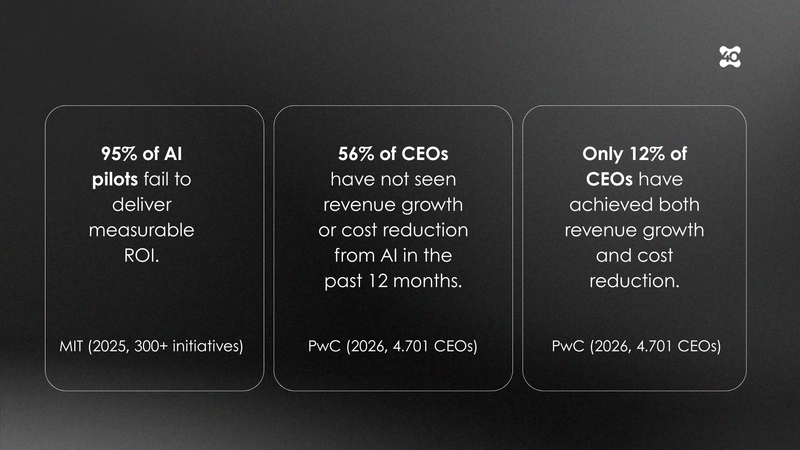
The data is clear. Most AI initiatives fail to generate measurable impact on revenue or operational efficiency. This gap between investment and return is not due to limitations of the technology, but to a structural issue in how AI is positioned within business strategy and within the broader concept of AI for business.
The core issue is not adoption. It is maturity.
Companies that treat AI as a tool tend to accumulate isolated pilots. Companies that treat AI as infrastructure build operational capability. This distinction separates organizations that scale consistently from those stuck in cycles of experimentation without real impact.
Read on to understand how AI maturity directly impacts business outcomes.
AI as Strategy: Why 95% Fail
Most AI initiatives fail because they are not integrated into business strategy. Instead of structuring AI as an operational capability, organizations treat it as a collection of isolated tools. Without governance, data integration, and clear financial metrics, gains remain incremental and fail to translate into systemic impact.
For AI to generate real business value, it must be embedded in core processes, supported by structured data, clear ownership, and well-defined financial indicators. Companies that capture value treat AI as infrastructure rather than experimentation, progressing through maturity levels until technology becomes a true operational capability.
The future of AI in business lies in the transition from support function to operational engine. More mature organizations use AI to anticipate demand, automate decisions, and operate with greater efficiency and speed. Competitive advantage is shifting from adoption to the quality of implementation.
AI for Business: The Structural Misstep
The dominant pattern in the AI market is fragmentation. Different departments launch independent pilots, adopt different tools, and pursue localized productivity gains. Initially, this approach creates positive signals. Tasks are accelerated, specific costs are reduced, and use cases emerge.
However, without integration, governance, and financial accountability, these gains do not scale. What emerges is a portfolio of disconnected initiatives that fail to produce systemic impact.
This phenomenon, often described as innovation theater, creates the illusion of progress. The organization appears to move forward, with projects, reports, and adoption metrics, but cost structure, operational efficiency, and value creation remain largely unchanged.
The root of the problem lies in the question guiding decision-making. Focusing on “which tools to use” keeps the discussion at a tactical level. What differentiates the top performers is a structural question: what is our level of AI maturity, and what must we build to evolve?
This challenge is not unique to AI. In service-based models, similar limitations emerge when growth depends directly on resource allocation, as discussed in the transition from agency to holding structures.
AI for Business: Maturity as a Strategic Variable
AI evolution follows a structured operational maturity model. This is not an arbitrary progression, but a sequence of stages with specific characteristics, limitations, and requirements.
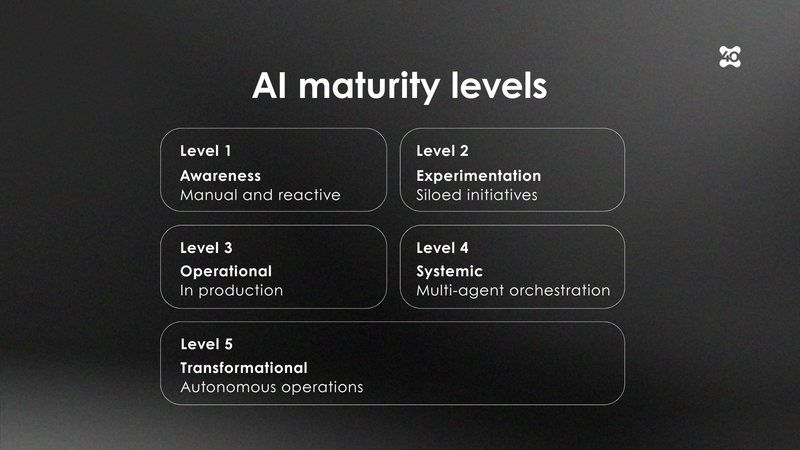
This maturity can be understood through five levels that define the real ability to generate value with AI.
Level 1 — Individual, Unstructured Use
At the initial stage, the organization lacks structure. AI usage is individual, inconsistent, and disconnected from business goals. Data is fragmented, decisions are largely intuitive, and there is no formal ownership.
Level 2 — Isolated Experimentation
The next stage introduces more organized initiatives, but they remain isolated. Pilots emerge across departments without integration, governance, or financial metrics to justify continuation. This is where most companies stagnate.
Level 3 — Operationalization
Transitioning to the operational level requires a qualitative shift. AI moves from experimentation to integration within core processes, with clear before-and-after metrics. Ownership is defined, data begins to be structured, and the organization develops the ability to measure real impact.
Level 4 — Strategic Integration
At this stage, progress becomes exponential. Cross-functional integration, workflow orchestration, and the connection between data, automation, and decision-making begin to directly impact revenue, efficiency, and acquisition. AI starts to influence strategic decisions.
Level 5 — AI-Driven Infrastructure
At the most advanced stage, AI evolves from support to operational engine. Processes become predictive, systems become adaptive, and human intervention focuses on exception handling. The operation is designed to scale with AI at its core.
Most companies still operate between levels 1 and 2. Some reach level 3. Very few achieve levels 4 and 5, and these are the organizations that build sustainable competitive advantage.
Just as with integrated digital growth models, AI maturity requires structural change, not incremental adoption.
The Critical Bottleneck: Why Most AI Initiatives Stall
The most common barrier occurs between experimentation and operationalization. This is a structural issue, not a technological one. Companies reach the experimentation stage with energy and curiosity, but lack the elements required to scale: organized data, system integration, defined governance, and clarity around financial impact.
Without these elements, pilots remain active but strategically irrelevant.
There is also a sequencing mistake that undermines many initiatives. Organizations attempt to automate processes that are not yet efficient. Introducing AI into poorly designed workflows does not solve inefficiencies. It amplifies and scales them. Process redesign is not a post-AI step. It is a prerequisite.
In marketing and e-commerce operations, this limitation directly translates into loss of competitiveness. While competitors evolve toward more efficient models, companies stuck in early stages accumulate operational costs that limit their ability to invest in growth.
The Five Dimensions of AI Maturity
Progress in AI depends on alignment across five structural dimensions.
1. Data Foundation
Data is the starting point. Without access to reliable, real-time information, any AI system operates with low accuracy and limited impact. Fragmented data reduces efficiency and prevents scalable automation.
2. Integration Layer
The tooling layer defines integration capability. Isolated solutions disconnected from core systems may improve individual productivity, but they do not transform operations. The real advantage lies in structured, secure integration with business workflows.
3. Team Capability
People determine the speed of adoption. Concentrating knowledge in a few specialists limits scale. Distributed capability, with advanced users embedded across teams, enables real transformation.
4. Process Structure
Processes offer the greatest leverage. Automating inefficient workflows perpetuates problems. Redesigning processes with an AI-first logic enables meaningful gains in efficiency and quality.
5. Governance Model
Governance ensures sustainability. Using AI without clear guidelines, especially when sensitive data is involved, introduces risks that may outweigh the benefits. Establishing standards, accountability, and controls is essential for safe scaling.
Advancing AI Maturity: From Intent to Execution
Maturity does not evolve through the accumulation of initiatives, but through strategic focus. The first step is a realistic diagnosis that identifies the primary bottleneck across critical dimensions.
From there, progress requires prioritization. Instead of expanding the number of pilots, organizations should focus on processes with the highest time consumption and greatest potential impact.
Appointing a dedicated owner with a clear mandate is often underestimated. Without leadership, initiatives tend to fragment and lose both coherence and speed.
Measurement discipline is what sustains progress. The focus must be on financial and operational metrics such as cost per transaction, cycle time, productivity per employee, and margin impact. Without this connection, AI remains in the experimentation stage regardless of how many initiatives are in place.
Want to see how companies are advancing across these maturity levels in practice? Explore hub40’s case studies to understand how AI is being applied with real business impact.
The Future of AI in Business: Impact of Maturity Evolution
Advancing AI maturity does not generate linear gains. It redefines how the operation functions. Each stage represents a step-change in efficiency, speed, and decision-making capability.
Operational Stage
At the operational level, companies begin to capture tangible efficiency gains. Manual activities are reduced, execution speed increases, and a more structured data foundation supports better decision-making.
Systemic Level
As maturity progresses, the main advantage shifts from efficiency to responsiveness. The ability to adjust pricing, inventory, and communication in real time changes competitive dynamics and enables companies to capture opportunities that were previously missed.
Transformational Stage
At the transformational level, the operational logic is inverted. Companies stop reacting to events and begin anticipating them. Problems are resolved before they impact the customer, and opportunities are captured before they become visible to the market.
At this stage, maturity does not just improve operations. It fundamentally redefines competitive positioning.