

In 2019, generative AI was not part of corporate roadmaps. By 2021, few anticipated that conversational interfaces would redefine search dynamics in less than two years.
The pattern is consistent. The future does not present itself clearly, but it leaves objective signals. Competitive advantage lies in the ability to interpret those signals before consensus, especially when it comes to AI in business and its direct impact on strategy.
This shift is closely connected to the evolution of AI from a tool to a structural foundation, as explored in "AI in Leadership: How to Empower People with Artificial Intelligence".
Read on to understand how these transformations are already reshaping strategy, operations, and growth.
The Market Does Not Wait for Decision-Making Maturity
Three simultaneous movements are already reshaping the competitive landscape of digital marketing in Brazil, directly impacting revenue, organizational structure, and brand positioning.
1. MarTech Expansion
The first is the rapid expansion of the MarTech market. Projections point to a $2.38 trillion market by 2033, with an average annual growth rate of 20.1 percent, significantly outpacing AdTech.
This shift moves the center of competition away from media investment and toward infrastructure. Data, automation, and AI for business applied to the customer journey become the new battleground.
2. The Rise of GEO
The second is the structural shift in search. Generative Engine Optimization (GEO) is no longer an emerging concept but is becoming a critical layer of visibility.
AI interfaces increasingly mediate consumer decisions, providing answers before traditional navigation even begins. Absence in these environments translates directly into lost relevance at the moment of decision.
3. Growth of the Brazilian Market
With high digital penetration and strong engagement, including more than three hours per day spent on social media, Brazil is positioned as one of the most promising e-commerce markets globally.
The expectation of entering the global top five by 2031 is not just about scale. It signals a competitive window. Companies that structure AI for business now will capture this growth with an advantage.
Three Forces Redefining Marketing by 2031
The five-year horizon is not speculative. It reflects the consolidation of trends already underway. Three forces concentrate the most relevant transformations.
1. Creative Production Is Being Reconfigured
The model based on manual production for broad segments is losing relevance as generative AI becomes the operational standard for content creation across formats. The differentiator shifts from volume to contextual precision.
Hyper-personalization at scale redefines the concept of campaigns. Instead of generic messaging for large audiences, brands must deliver variations tailored to each user’s context.
This is more than a technological shift. It is structural. Companies with strong brand identity, robust proprietary data, and clear governance are better positioned to capture value from AI.
2. The End of the Linear Funnel
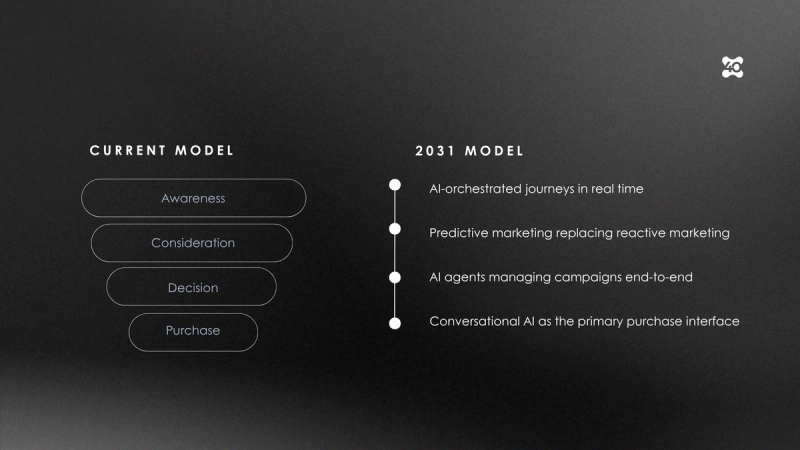
The traditional journey model, moving from awareness to conversion, assumes a linear sequence. That logic no longer holds. The customer journey becomes dynamic, adaptive, and predictive, with behavioral and contextual signals driving automated decisions on messaging, offers, and timing.
In this environment, AI agents manage campaigns end to end, while conversational interfaces become central points of interaction and purchase.
The operational implication is clear. Long planning cycles are no longer compatible with market speed.
This transformation is directly linked to AI's role in decision-making, not just execution, as explored in "Operationalizing AI: The 5 Levels Of Maturity".
3. Brazil as a Leapfrog Market
Markets with high digital adoption and less legacy infrastructure tend to advance faster. In Brazil, this enables direct adoption of advanced solutions without the need for intermediate stages.
Initiatives such as AI-driven demand forecasting, logistics automation, and conversational experiences are no longer future projects. They are delivering short-term impact. Operational cost reductions, estimated between 30 and 40 percent in logistics and inventory, reinforce this advantage.
At the same time, the customer journey is shifting toward conversational environments. In this context, traditional SEO remains relevant, but GEO becomes more central in capturing demand.
The Strategic Cost of Waiting
There is a common pattern among experienced leaders: delaying structural decisions until the landscape becomes clearer. In fast-moving environments, this approach leads to lost competitive advantage.
Companies that led AI adoption in recent years did not necessarily predict the future with precision. They built adaptability by investing in proprietary data, structuring processes, and developing a culture of experimentation.
The same pattern applies to GEO, journey automation, and conversational commerce. The difference is not in how fast tools are adopted, but in how early the necessary assets are built to generate real impact.
In Brazil, the cost of inaction is measurable. The projected growth of e-commerce will be captured by operations with lower acquisition costs, faster response times, and superior logistics efficiency.
Five Non-Negotiable Decisions
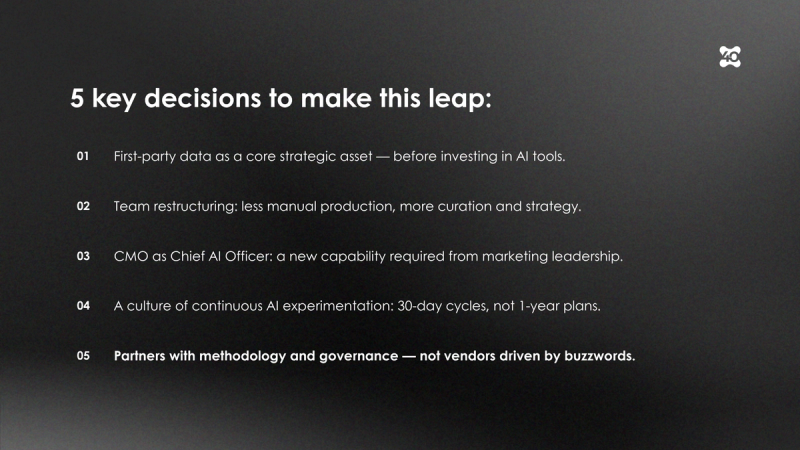
Moving from experimenting with AI to operating with AI requires structural decisions. Five stand out as urgent.
First, first-party data must be treated as a core asset. The foundation of any AI strategy is the quality and depth of available data. Without well-structured proprietary data, technology delivers generic and undifferentiated results.
Second, teams must be reconfigured. Automation reduces manual production but increases the need for strategic curation. Teams must shift from execution to qualified supervision, focusing on direction, validation, and optimization.
Third, the role of the CMO evolves. Marketing leadership becomes directly responsible for AI strategy, including understanding models, governing data, and connecting technology to business outcomes.
Fourth, operational cycles must shorten. The ability to test hypotheses, measure financial impact, and iterate quickly becomes essential. Rigid annual planning structures lose relevance.
Fifth, partner selection becomes critical. The difference between a strategic partner and a vendor lies in the ability to connect technology implementation to concrete financial metrics. Execution with method and governance outperforms trend-driven narratives.
What Separates Leaders from Followers
The difference between leading and following companies is not budget or scale. It is how they operate.
Leading organizations already use AI in production, treat data as a strategic asset, and operate with short decision cycles. They also work with partners who bring method and accountability.
Followers remain in evaluation mode, depend on external platforms for critical decisions, and maintain planning structures that are incompatible with market speed.
In this context, the hub40 ecosystem positions itself as an integrated operational structure, connecting SEO, e-commerce, data, and technology to drive measurable impact. The results observed are not based on theoretical foresight, but on structural decisions made ahead of consensus.
The 2031 landscape will not be defined by those who best predict trends, but by those who build adaptability today. The central question is no longer what will happen, but what is being built now. Competitive advantage does not emerge at the moment of change. It is constructed beforehand.
The difference between following the market and leading it lies in how operations are structured today. Companies that move ahead do not wait for clarity. They build capability now.
We hope this content has helped expand your perspective on the topic. We invite you to explore hub40’s results in practice on our case studies page.