

AI in Leadership: How to Empower People with Artificial Intelligence
Understand how artificial intelligence in business evolves from a tool into a culture, enhancing human decision-making.
The growing discussion around artificial intelligence in business since 2023 has led to a surge of tools, pilot initiatives, and training programs. However, much of this movement has been driven by a tactical mindset focused on adopting specific solutions rather than building structural capability.
While this approach can generate incremental productivity gains, it rarely translates into sustainable competitive advantage. The key distinction lies not in using AI, but in structuring operations so they are amplified by it.
The experience of liveSEO, a company within the hub40 ecosystem, offers a clear perspective on this difference. By starting its AI integration as early as 2019, the organization not only anticipated a trend but also built an operational foundation that now delivers measurable gains in scale, speed, and efficiency.
The central question is no longer whether AI will be adopted, but how it will be embedded into company culture and operational logic.
AI for Business as Operational Infrastructure
Using AI as infrastructure means integrating the technology into core business processes, enabling scalable operations, increased productivity, and consistent competitive advantage.
In this context, AI moves beyond isolated use cases such as simple automation or writing assistance and becomes part of the broader operational logic. The benefit shifts from incremental efficiency to structural capability.
This shift requires more than adopting tools. It involves developing internal capabilities to identify where AI creates real value, understand its limitations, and integrate it consistently into existing workflows.
Organizations that build this foundation early operate with greater adaptability, lower marginal costs, and a stronger ability to capture efficiency gains at scale.
If your goal is to understand how to position AI as a strategic operational layer, the content “Operationalizing AI: The 5 Levels Of Maturity?” explores this topic in greater depth through the lens of maturity and value creation.
AI for Business and Operational Scale: The Role of Architecture
AI integration tends to generate meaningful impact when it follows a horizontally scalable logic. Instead of concentrating AI in isolated functions, distributing AI agents across operational workflows, from content production to software development, expands both reach and efficiency.
This model significantly increases productive capacity without proportional growth in resources. Task volume scales while the organizational structure remains lean, demonstrating clear operational leverage.
The outcome is not driven by the tool itself, but by the architecture supporting its application. When AI is embedded as infrastructure, it acts as a force multiplier. When it remains limited to isolated initiatives, its impact tends to be constrained and short-lived.
This distinction defines competitiveness in the medium term. Organizations that adopt AI in a systemic way operate with greater efficiency, faster response times, and higher adaptability.
Time as a Strategic Asset
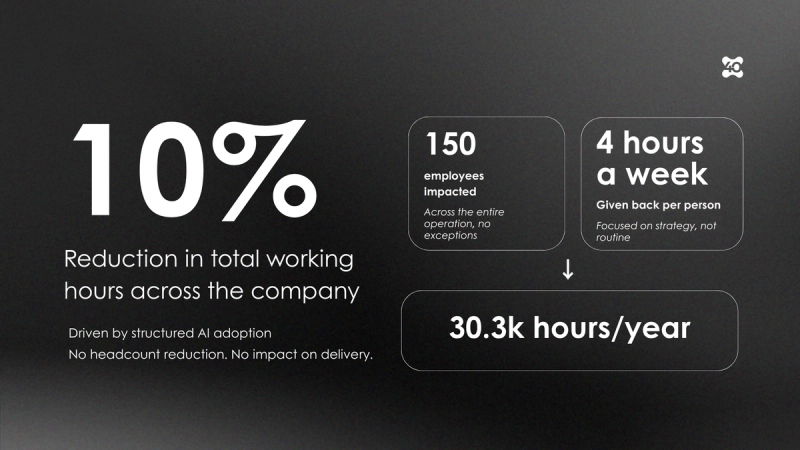
One of the most tangible effects of structured AI integration is the redistribution of time within the organization. By automating repetitive and predictable tasks, companies free up human capacity for higher-value activities.
In the case of liveSEO, the average return of four hours per week per employee represents more than an efficiency gain. It reflects a reallocation of organizational effort. Time previously spent on execution is redirected toward analysis, decision-making, and strategic development.
This shift affects not only productivity but also the quality of output. In highly competitive environments, the ability to think better, not just execute faster, becomes a critical differentiator.
The Competitive Asymmetry of AI in Business
Adopting AI as infrastructure creates a competitive asymmetry that compounds over time. While companies operating under traditional models maintain relatively stable output capacity, organizations that structure AI expand their output continuously without proportional team growth.
This effect accumulates with each learning cycle as processes are optimized and new applications are integrated into operations.
There is also a critical timing factor. The window for competitive advantage in AI does not remain open indefinitely. As adoption becomes widespread, the differentiator shifts from adoption itself to the maturity of implementation.
Companies that start late must not only catch up but do so in a more competitive environment with less margin for error.
To understand how this shift impacts visibility in e-commerce, it is worth exploring “The New Search Paradigm: How Ai Redefines Visibility In E-commerce.”
Infrastructure, Culture, and Governance: The Three Pillars of Scale
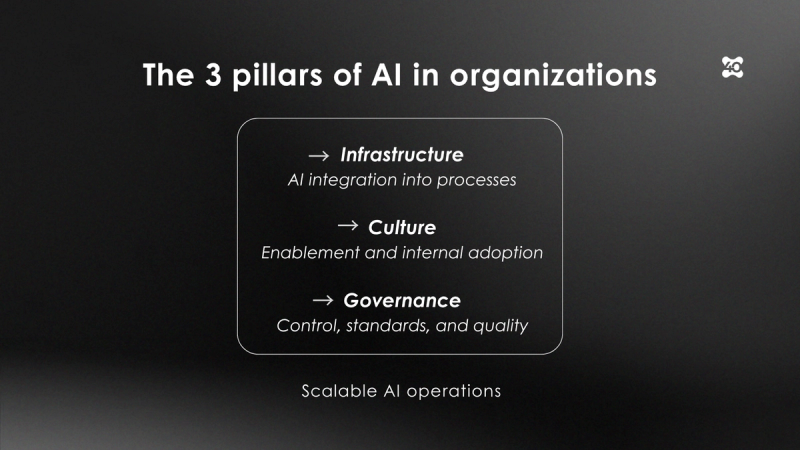
Building an AI-driven operation depends on three interdependent dimensions.
Infrastructure represents the technical and operational foundation. It involves integrating AI into workflows, focusing on high-volume, low-variability tasks with strong automation potential.
Culture is often overlooked but is what enables adoption at scale. Developing internal AI capabilities ensures that transformation happens consistently rather than as isolated initiatives.
Governance ensures consistency and quality. Clear guidelines, usage standards, and validation mechanisms prevent fragmented adoption, reduce operational risk, and ensure reliable outcomes.
AI’s Impact on Performance and Cost Structure
When these three pillars are aligned, the impact becomes visible across multiple dimensions. Productive capacity increases significantly, allowing companies to deliver more without expanding fixed costs.
Execution speed improves, reducing time to market and increasing competitiveness. At the same time, return on investment in AI shifts decision-making from a cost perspective to a value generation mindset.
There is also a qualitative impact on work, with higher engagement and stronger innovation capacity.
AI as an Amplifier of Human Decision-Making
The perspective guiding hub40 companies is based on a clear principle. Artificial intelligence does not replace human decision-making. It amplifies it.
Machines execute, process, and scale. Humans interpret, contextualize, and define direction. The combination creates a more efficient and resilient operating model.
The balance between automation and human judgment sustains long-term value creation.
Strategic Insights for Leaders
Embedding AI as infrastructure requires decisions that go beyond tool selection.
Prioritization should be driven by impact rather than ease of implementation. High-impact use cases should come first.
Integration with existing processes is more valuable than creating parallel initiatives, since isolated projects tend to generate limited systemic impact.
Enablement must be continuous and distributed. Concentrating knowledge in a few specialists limits scalability.
Measurement must capture not only efficiency gains but also impact on capacity, speed, and quality.
The Future of AI in Business
AI adoption in the corporate environment is no longer a matter of innovation. It is a defining factor of competitiveness.
The differentiator is not the use of technology itself, but how it is integrated into operations. Companies that treat AI as a tool tend to achieve marginal gains. Those that structure it as infrastructure build lasting capability.
This transformation does not happen overnight. It results from continuous development that combines technical learning, cultural evolution, and governance discipline.
For leaders, the implication is clear. Competitive advantage in AI will not be defined by who adopts it first, but by who structures it best.