

There comes a critical point in the trajectory of service-driven businesses where growth is no longer a demand problem—it becomes structural. Up to a certain stage, adding clients and expanding teams can sustain growth. However, this model has a built-in limitation: linear cost growth inevitably puts pressure on margins and increases operational complexity.
At that point, mature organizations don’t just revisit their processes—they rethink the very nature of their business model. The question shifts from “how do we grow more?” to “how do we grow better—without compromising efficiency and predictability?”
The hub40 journey illustrates this inflection point. More than an organizational evolution, it represents a structural shift that repositions the company within the digital ecosystem and offers relevant insights for leaders facing similar challenges.
The Structural Limits of the Service Model: Operating in a Mature Market
The founding of liveSEO in Spain in 2017 is more than a milestone—it’s foundational to its operating logic. Unlike emerging markets, where best practices are still evolving, the European landscape already demanded technical maturity, methodological rigor, and a high level of accountability.
Operating in this environment requires robust processes from day one. The cost of failure is high, tolerance for unstructured experimentation is low, and differentiation depends less on narrative and more on consistent execution.
This foundation was critical to sustaining growth. Companies born in mature markets tend to internalize operational discipline early—often before facing scaling pressures—reducing the need for late-stage structural adjustments.
Entering Brazil: Digital Growth and Timing as a Strategic Advantage
The decision to expand into Brazil in 2018 was a strategic move combining market insight with a strong risk appetite. At the time, SEO was still underdeveloped in the country—both technically and strategically.
Entering a market in formation requires tolerance for uncertainty, but it offers a meaningful upside: the ability to shape standards. Early movers don’t just capture initial demand—they help define benchmarks, educate clients, and build indirect competitive barriers.
This creates a less visible yet structural advantage. By shaping how a discipline is perceived, a company also influences the criteria by which it is evaluated—reducing commoditization pressure in the mid-term.
2020: Growth in an Adverse Scenario as Model Validation
The 2020 pandemic acted as a stress test for service-based companies. The dominant market response was defensive: cost-cutting, contract suspensions, and reduced investment.
liveSEO’s decision to accelerate during this period reflects a deeper understanding of SEO demand dynamics. Unlike paid media channels, organic search reflects active user intent. In times of crisis, that intent doesn’t disappear—it shifts.
Choosing to maintain and expand operations requires confidence in the model and clarity about the strategic role of the channel. The 23% CAGR (2021–2026) should be seen as the result of a method-driven operation with strong execution capabilities—well before the external shock.
Crises don’t create competitive advantage—they reveal who was already positioned to capture it.
What Is a Holding—and Why the Model Needs to Evolve
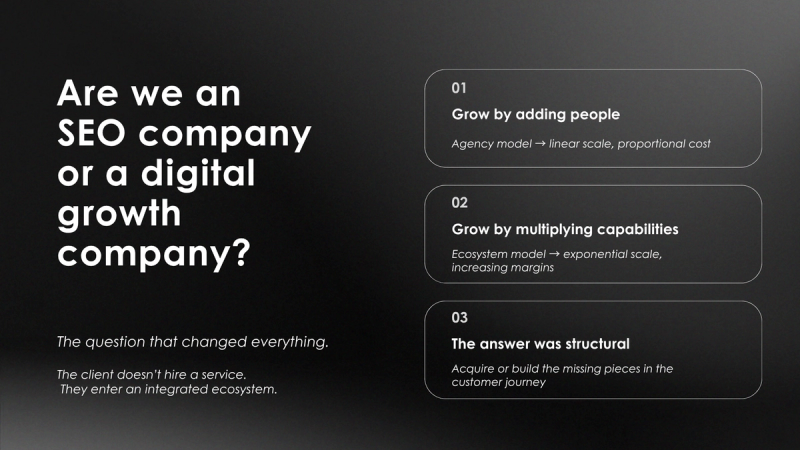
With sustained growth comes the inevitable ceiling of the traditional agency model. At its core, this model scales through headcount. Every new client requires more hours, more specialists, and, consequently, higher costs.
This dynamic creates an implicit cap: margins tend to stabilize—or decline—as operations scale. At the same time, management complexity increases non-linearly, requiring additional layers of control, coordination, and alignment.
At this stage, the strategic question must evolve. Continuing to scale under the same model means accepting a direct correlation between growth and cost—undermining long-term efficiency and scalability.
This is where hub40 redefined its position: moving from an SEO-centric company to a structure focused on integrated digital growth.
The Holding Model: Scale, Efficiency, and Business Leverage
Transitioning to a holding model is not just a corporate restructuring—it’s a shift in how value is created. Instead of scaling through service volume, hub40 scales by expanding capabilities.
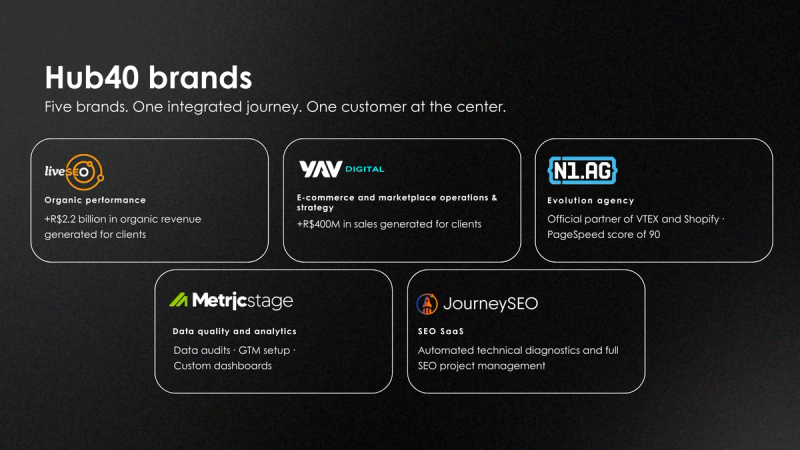
Integrating multiple verticals—such as technical SEO, e-commerce operations, headless infrastructure, data intelligence, and SaaS-driven automation—creates a compounding effect. Each new capability not only adds revenue potential but also increases the overall value proposition.
This shift transforms client relationships. Instead of hiring isolated services, clients operate within an ecosystem where multiple capabilities work in sync toward shared business goals.
From an economic standpoint, this reduces reliance on billable hours while increasing contract depth and recurring revenue. Strategically, it brings the company closer to the client’s core decision-making layer.
Want to see how this model performs in practice? Explore our case studies and see how each company within the ecosystem delivers results.
Integration as a Competitive Advantage
The formalization of hub40 as a holding in 2025 solidified this model. However, the real differentiator isn’t the existence of multiple brands—it’s the level of integration between them.
Fragmented ecosystems are common—but rarely efficient. True advantage comes from interoperability across data, methodological alignment, and a unified growth vision.
This integration enables decision-making based on a holistic view of the customer journey—connecting acquisition, conversion, retention, and operational efficiency. In a landscape where data is abundant but often siloed, this capability becomes a key competitive differentiator.
Market Context and the Fight for Competitive Advantage
hub40’s evolution takes place within the rapid expansion of the MarTech market, projected to reach $2.38 trillion by 2033, with annual growth exceeding 20%. At the same time, the SEO market in Brazil continues to grow steadily, with estimates reaching $5.3 billion by 2030.
However, this growth is not evenly distributed. As markets mature, competition shifts from presence to relevance and efficiency. Isolated solutions tend to lose ground to integrated approaches that directly impact revenue and margins.
In this context, positioning at the intersection of technology, data, and organic performance is not just an opportunity—it’s a strategic imperative for companies seeking sustainable digital growth.
Strategic Takeaways for Leaders
The hub40 journey highlights several practical insights for executives and decision-makers:
- Method precedes scale: sustainable growth is not driven by speed, but by solid processes that enable scaling. Scaling without structure amplifies inefficiencies;
- Timing is a strategic asset: early entry into emerging markets allows companies to shape demand and build structural advantages;
- Business models must evolve: what works in early stages often becomes a constraint at scale. Reassessing the model is part of the growth journey;
- Integration drives efficiency: in complex environments, the ability to connect capabilities is more valuable than isolated excellence;
- Growth is not just volume: revenue quality, recurrence, depth of relationships, and business impact matter as much as absolute scale.
Ignoring these factors often leads to growth with compressed margins, low predictability, and higher exposure to market cycles.
Digital Growth Requires Structural Evolution
The transformation from a specialized SEO operation into an integrated digital growth holding should not be seen as a one-off move, but as a response to broader market dynamics.
As the digital landscape becomes more complex and data-driven, fragmented operating models tend to lose efficiency and relevance. On the other hand, organizations that integrate capabilities, align strategy, and execute consistently are better positioned to capture value.
The hub40 case reinforces a key principle: true scale doesn’t come from adding more resources—it comes from reconfiguring the business model to sustain efficient growth. For leaders, the takeaway is clear: the strategic question guiding your organization today may not be the one that secures your competitive advantage tomorrow.